
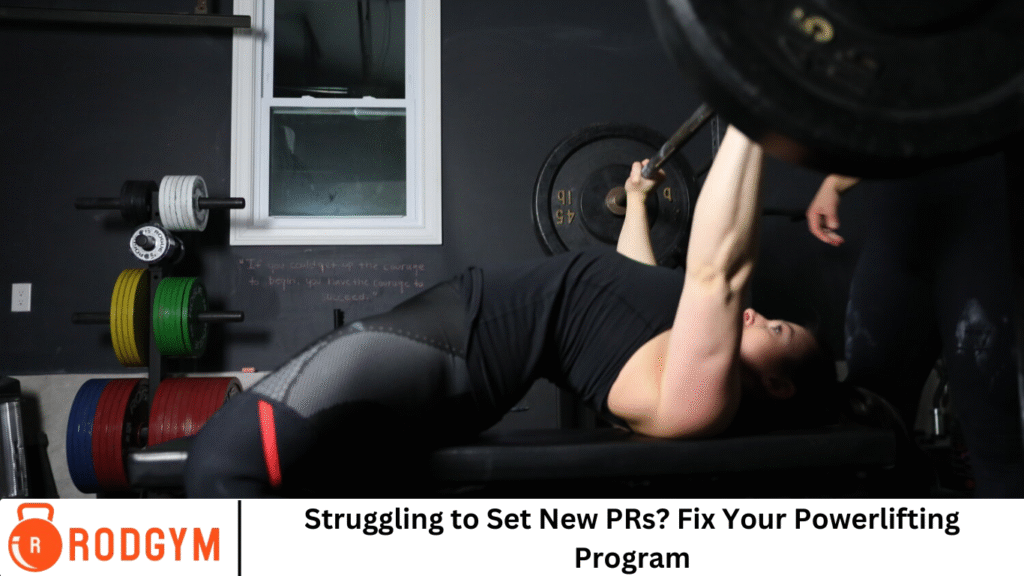
Are you stuck in a powerlifting plateau, unable to break through and set new personal records (PRs)? You’re far from alone. Whether you’re a seasoned lifter or a competitive powerlifter lingering just under your PRs, slow progress is frustrating.
The good news? With a few strategic tweaks to technique, training volume, recovery, and programming, you can revive your progress and finally break through that barrier.
In this comprehensive guide, you’ll discover practical, actionable ways to retool your powerlifting program, smash past stalls, and set new PRs in squat, bench press, and deadlift.
More Read: 5 Safe Workouts for Getting Back Into Exercise After a Sports Injury
1. 🎯 Identify the True Limiting Factor
Before making any changes, identify why you’re struggling:
- Technique breakdown – Do you lose tightness under heavy weight?
- Volume mismanagement – Are you under- or over‑training?
- Recovery slips – Insufficient sleep, nutrition, or stress management?
- Weakness imbalances – Poor core strength, upper back, glutes?
- Program rigidity – Skipping deloads, ignoring feedback?
Once you pinpoint the main culprit, you can tailor a solution that fixes the root problem—not just the symptoms.
2. Refine Your Lifting Technique
Weak technique = missed PRs. Even slight technical issues under load can make lifts grind to a halt.
Squat:
- Drive from the hips.
- Maintain a braced core.
- Position knees around ankle—not in front.
- Depth: hip crease just below parallel.
- Film 2–3 sets monthly to catch hitching or forward lean.
Bench Press:
- Retract your Scapula.
- Tuck elbows (~45°) to reduce shoulder stress.
- Tight upper back and arched chest lowers bar path.
- Keep the bar path vertical over your wrists and elbows.
Deadlift:
- Chest high, back flat.
- Compress the bar against the shins.
- Engage lats and grip hard.
- Finish by thrusting the hips forward—don’t just pull.
Key Tip: Film your lifts often, compare against elite technique standards, and consult a coach or study slow-motion critiques.
3. Rethink Your Training Volume
Volume (sets × reps × weight) is critical—too much can overtrain; too little impedes strength gains.
- Start at 50–65% of 1RM volume and gradually build up.
- Monitor recovery using rates of perceived exertion for soreness or heaviness.
- Deload every 4–8 weeks depending on training age.
Mad Dog 20/10: Squat bench and deadlift twice weekly.
Consider a specialization mesocycle, focusing one lift each week while maintaining lower volume for the others—perfect for PR push phases.
4. Program Adjustments to Escape Plateaus
If your program’s stagnant, revise one aspect at a time:
Frequency:
- Increase lifting a lift twice weekly (e.g., Squat on Mon and Fri).
- Or deload frequency by lifting once heavy, once light.
Intensity Variety:
- Use RPE (Rate of Perceived Exertion) rather than fixed %.
- Integrate heavy (.85–.95RM), medium (.75–.85RM), and light (<.75RM) days.
Peaking Phases:
- In weeks 8–12 of a 16‑week cycle, shift to lower-volume, higher-intensity work.
- Delay two heavy lifts to separate days or weeks (e.g., deadlift light week after squat-heavy week).
Accessory and Weak-Point Training:
- Struggling with lockout? Add rack pulls, deficit deadlifts.
- Weak off-chest bench? Try floor presses, lock-out work, or shoulder rehab.
- Squat unstable or slow out of hole? Add box squats, pause squats**, glute/hip work.
5. Smart Use of Peaking
In the final 4–6 weeks before a competition or PR attempt:
- Cut volume by ~40–50% while maintaining intensity of 90%+.
- Schedule lifts days apart, not back-to-back (e.g., Squat Monday, Deadlift Thursday).
- The goal: hit high intensity without lethal fatigue accumulation.
Sample Peaking Template (Meet Prep Week 1–4):
- Week 4: Heavy triples & doubles (85–90%) – train squat & bench lightly if deadlift is heavy week.
- Week 3: Heavy singles (90–95%) – spatial spacing heavy days further apart.
- Week 2: Heavy singles (93–98%), minimal volume – compete weight & feel-specific tension.
- Week 1: Taper — Singles at ~90%, no fatiguing work.
- Peak Week (Meet): Warmups, then PR attempts.
6. Prioritize Recovery and Deloads
Recovery is where strength work happens. If your body can’t bounce back, heavy sessions stagnate.
Sleep:
- Aim 7–9 hours nightly.
Nutrition:
- Consume 1.6–2.2 g protein per kg of bodyweight.
- Fuel daily calories slightly above maintenance on high-intensity weeks.
Soft-Tissue & Mobility:
- Add targeted foam rolling of quads, hamstrings, glutes, pecs, thoracic spine.
- Daily activation drills: band pull-aparts, resisted hip extensions (20–30 reps).
Stress busters:
- Keep life stress in check—work, family, etc. affect recovery via cortisol.
Deload Blocks:
- 4–8 weeks into training, reduce volume by 30–50%.
- Use lighter sets or just reduce accessory work.
7. Programming Example: Specialist + Deload Strategy
12‑Week Example Training Block:
- Weeks 1–4 (Base Phase): Medium volume (65–75% 1RM), 2×/week per lift.
- Weeks 5–8 (Specialization Phase):
- Priority lift (e.g. squat) → 3×/week moderate intensity (75–85%)
- Other lifts → 1×/week main heavy + 1–2 light/tactical
- Weeks 9–11 (Peaking Phase): Low vol, high intensity
- Heavy singles, with alternating heavy lifts
- Deload built-in each week
- Week 12:
- Meet week — warmups, openers, PR attempts
Throughout the cycle:
- Adjust weekly volume and intensity based on performance, rail towards RPE 8–9 during heavy days.
- Incorporate back-off sets, blocks for technical focus.
8. Use RPE Over Strict %s
Moving Your Program from Rigid to Responsive:
- Rate every set using RPE moves you from “one-size-fits-all %” to daily auto-regulation (e.g., RPE 7–9).
- If you hit RPE 9 last squat set for squat ≈ put a rep or two in reserve—good intensity.
- Over a few cycles, RPE outperforms static percentage planning in promoting steady PRs.
9. Don’t Mystify Supplements, but Use Smartly
Supplements aren’t magic, but some supports help:
- Creatine Monohydrate: Improves strength, power, and recovery.
- Protein powder: Helps hit daily protein targets.
- Omega-3s: Anti-inflammatory, joint support.
Avoid overloading on unproven ergogenic aids. Focus 80% on training + recovery fundamentals, 20% smart supplementation.
10. Track Metrics, Not Just PRs
Outside PR attempts, track:
- Velocity: Barbell speed, measured via apps or devices.
- Volume Accumulation: Weekly/recent 4-week volume total.
- RPE Trends: Compare same % and weight sessions.
- Accessory Performance: Lockout work, pause lifts, isometrics.
These micro‑metrics give early warnings about recovery and readiness, letting you add or reduce volume in time—no red flags later.
11. Coaching Masters Lifters? Adjust Strategies
Masters lifters (35+) need recovery-conscious programming:
- Smaller ‘training budget’—less cumulative stress.
- Frequency and volume reductions mitigate errors.
- Use a specialization model: one lift at 35–45% normal volume every 7–10 days; heavy focus on the other.
- Peaking: space max-effort sessions 50–100% further apart than normal.
- Alternate heavy weeks—e.g., squat focus one week, deadlift the next.
This allows PR peaking while respecting the body’s slower recovery timeline.
12. Break Common PR Barriers
Nervous System Burnout:
- Symptoms: fatigue, insomnia, soreness, irritability.
- Solutions: crisp deloads, no-volume weeks, extra sleep days.
Grip Weakness for Deadlift:
- Use double-overhand straps, farmer’s walks, prefatigue the grip.
Bench Speed Off Chest:
- Try board presses, pause bench, triceps and shoulder volume.
Squat Confidence Near Depth:
- Use pause squats, box squats, hip mobility drills, numeric goal for depth awareness.
13. Mindset Shifts that Empower PR Progress
- Process > PR: Emphasize comp‑able Single reps each week—if daily performance improves, PRs follow.
- Learn when to say no: Despite volume temptations, opt for extra recovery when body tells you.
- Journal: Log daily energy, soreness, sleep, stress, nutrition. Correlate to performance.
- Benchmark test phases: Every 12 weeks, test singles (not max every week).
14. Real-World PR Comebacks
- Case A: Coach had bench go from 345 → 365 in 12 weeks. Heavy singles + pause bench. Strength principle leveraged incremental overload, peaked with RPE-based ramp.
- Case B: Squat plateau; converted to double-squat frequency + speed work; 2RM increased 10 lbs in 6 weeks.
- Case C: Masters lifter had PRs stuck at 400 in squat. Specialization style, plus 7-day frequency → 415 in meet. Key? Volume management & spacing of fatigue.
15. Your 5-Point Action Plan
- Audit your program: Volume, intensity, recovery, weak-point training, technique.
- Pick one thing to fix: Don’t change everything at once.
- Track your outcomes: Volume, RPE, accessory performance.
- Deload/test cycle weekly: Mini-taper every 6–8 weeks → test top single.
- Keep learning: Film, get coaching, read, reflect.
Frequently Asked Question
Why am I not hitting new PRs even though I’m training consistently?
Consistent training is important, but if you’re not progressing, it’s likely due to one or more of the following:
- Lack of progressive overload
- Poor recovery (sleep, nutrition, stress)
- Stale programming or no variation
- Weaknesses in technique or muscle imbalances
To break through, you need to reassess intensity, volume, recovery, and weak points.
How often should I attempt a new PR in powerlifting?
Most lifters benefit from attempting new PRs every 8–12 weeks, typically at the end of a training cycle. Frequent max attempts can lead to fatigue and burnout. Instead, build momentum through submaximal lifts, and use variations like AMRAPs or heavy singles to track progress.
Should I increase training volume or intensity to break a plateau?
That depends on the context:
- If you’re under-recovered or constantly sore: reduce volume.
- If your lifts feel easy and you’re coasting: increase intensity or add a top set.
- For many lifters, cycling between volume and intensity blocks yields the best results.
How do I know if I need a deload week?
Common signs you need a deload include:
- Joint aches and chronic soreness
- Decreased performance despite rest
- Poor sleep or mood swings
- Lack of motivation to train
A deload week every 4–8 weeks can restore performance and help set up your next PR.
Is it normal to plateau in one lift while progressing in others?
Yes. Strength gains are rarely linear across all lifts. It’s common to plateau in one lift (often bench press) while others progress. This could be due to:
- Movement-specific fatigue
- Neglected accessory work
- Weak links (e.g., triceps for bench, hamstrings for deadlift)
A focused specialization block can help bring that lift up.
Can Masters lifters still hit new PRs?
Absolutely—but they must train smarter. Recovery capacity is often lower, so:
- Space out heavy sessions more
- Use more submaximal work
- Rotate lifts and manage joint stress
Many Masters lifters hit lifetime PRs using smarter programming, not just harder training.
What’s the fastest way to fix a broken powerlifting program?
Start with a program audit:
- Are you progressing volume or intensity?
- Are you sleeping and eating enough?
- Is your technique solid?
- Are you training your weak points?
Fix the biggest gap first—whether it’s recovery, poor lift frequency, or lack of peaking—and track results over 3–4 weeks before making further changes.
Conclusion
Breaking plateaus in powerlifting requires more than willpower—it needs systematic, intelligent programming. Nail your technique, manage volume and recovery, specialize for peaking, auto-regulate with RPE, and track micro-progressions—not just PRs. Even if you’ve been stuck for months, recalibrating your approach can shift stagnation back into momentum. The next new PR—whether in squat, bench, or deadlift—is waiting once your program works with your body, not against it.
