
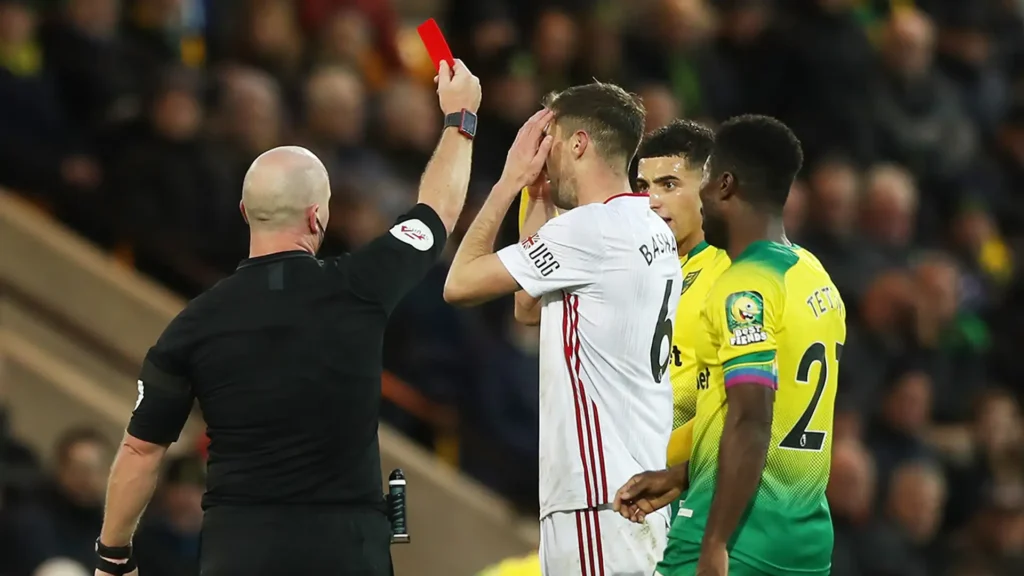
Survival matches at the bottom of the 2018/2019 Premier League table compressed fear, urgency and physical football into 90 tense minutes. That pressure did not just affect scorelines; it also increased the likelihood of cards and, in specific situations, penalty incidents that directly reshaped both the relegation race and betting markets.
Why survival stakes naturally push card risk up
When staying in the league is worth tens of millions in TV and prize money, players and coaches tolerate more physical risk to prevent goals. Discipline frameworks in the Premier League make that gamble costly: five yellow cards before matchweek 19 bring a one-match ban, 10 by matchweek 32 bring two, and 15 across the season mean three games suspended. A single red card ejects the player immediately and usually triggers at least a one‑match ban, with serious foul play or violent conduct drawing three games or more.
In relegation fights, that structure forces a trade‑off. Defenders know a tactical foul to stop a one‑on‑one or a dangerous break can save a point but also risks a yellow, a red or even a penalty if mistimed. As nerves rise late in the season, those borderline decisions become more frequent, pushing up both card volume and the chance of penalty‑box fouls when attackers surge through under pressure.
Which 2018/2019 teams sat in the relegation battle and what that implied
The 2018/2019 relegation struggle revolved around Fulham, Huddersfield Town and Cardiff City, who ultimately went down, and a cluster including Brighton, Southampton, Burnley and Newcastle who hovered near danger at various points. These teams typically conceded many goals and spent long spells defending deep, especially in direct “six‑pointers” against one another. That pattern concentrates defensive actions—tackles, clearances and blocks—around their own penalty area.
Discipline statistics for that season show that some of these clubs also ranked high in total yellow cards. NDTV’s team card table for 2018/2019 lists Fulham with 70 yellows and Cardiff with 67, while Burnley and Southampton recorded 76 and 74 respectively, putting them near or in the top tier for cautions. Those totals do not prove every survival match was card-heavy, but they highlight that several relegation candidates combined sustained defending with relatively aggressive individual behaviour, a mix that enhances card risk in high-stakes fixtures.
How yellow and red card rules intersect with relegation pressure
The league’s accumulation rules create a background tension in survival games. A player nearing five or 10 yellows faces the threat of missing a critical future match, yet the same player may be forced into risky challenges to stop immediate danger. Official guidance summarises the thresholds like this: five yellows by match 19 yield a one‑game ban; 10 by match 32 bring two games; 15 at any point bring three. Red cards come with their own suspensions—typically one match for a second yellow or professional foul, and three or more for serious foul play or violent conduct.
In relegation battles, especially close to the end of the season, this creates two distinct scenarios. In some matches, players already on four or nine yellows may pull out of marginal challenges to avoid suspension for the next “bigger” game, slightly lowering card risk but possibly increasing penalty risk if they hesitate at the wrong moment. In other matches, especially must‑win situations, players disregard future suspensions and focus on the immediate result, making cynical fouls and last‑ditch tackles more likely even if they push card counts upward.
Mechanisms that raise penalty probability in survival games
Penalties grow out of a specific combination of territory, pressure and decision‑making. Relegation battles increase all three inside the defending team’s box:
How survival football feeds penalty risk
- Sustained defending in the area
Struggling sides often sit deep and allow opponents to dominate possession near their box. That means more duels and tackles inside or just inside the area, where even small mistimings can be punished with a penalty. - Desperate last‑ditch challenges
In high‑stakes moments—late in six‑pointers, or when a team is clinging to a lead—defenders are more willing to slide, pull shirts or step across attackers rather than concede a clear shot. Those interventions raise the odds of a foul being called, especially when opponents fall under contact. - Referee sensitivity to decisive incidents
The 2018/2019 season was the last before VAR came into the Premier League, but debates around disputed penalty calls and the impending technology were already intense. A Sky Sports review highlighted a late‑season Cardiff match where the Welsh side, fighting relegation, led 1–0 but were denied two penalties before chaos in the final minutes. That case illustrates how critical penalty decisions in survival games could be and how much pressure fell on the officials.
In aggregate, this means that matches where a relegation-threatened team must defend deep for long stretches, particularly against stronger opponents, inherently carry higher penalty potential than mid‑table dead rubbers with low tempo and lower stakes.
Comparative view: relegation six-pointers vs normal fixtures
A useful way to think about card and penalty risk is to compare survival games to standard mid‑table fixtures along a few axes:
| Match type | Emotional stakes and incentives | Likely impact on cards and penalties |
| Relegation head‑to‑head (“six‑pointer”) | Both teams under huge pressure; a loss massively damaging | Elevated yellow risk, some red risk, higher penalty potential near the end |
| Relegation team vs safe mid‑table side | One side desperate, one relaxed; tactical mismatch likely | More cards for the struggling side; penalties if defending deep under siege |
| Mid‑table vs mid‑table, little at stake | Limited emotional load; tactical experimentation more likely | Closer to league-average cards, lower penalty concentration |
This structure matches broader observations from betting guides and statistics: stakes and defensive workload correlate with more fouls and bookings, while games with little on the line drift back toward baseline disciplinary numbers.
Where UFABET fits into a card-and-penalty conscious survival-game routine
For someone serious about using these dynamics, the key is to let the logic steer decisions before any prices are involved. A structured routine could look like this: you first identify which 2018/2019 fixtures qualify as genuine relegation battles—either direct six‑pointers or matches where at least one team is within a few points of the drop zone. Next, you check disciplinary tendencies: team yellow counts, known hot‑headed players, and how often these sides already featured in high‑card games. Only then do you consider whether card or penalty markets offer realistic value, for instance if lines are set close to league averages despite clearly higher stakes and deep defending. When you eventually decide to place those bets through a chosen web-based service such as ufabet เว็บตรง ไม่ผ่านเอเย่นต์, you are simply implementing a plan grounded in team profiles and match context, not reacting to last‑minute hunches.
How a casino online setting can amplify or blur these signals
Because red cards and penalties are dramatic, they attract outsized attention in highlight packages and promotional material, especially on survival weekends. Operators know this and often feature special offers or boosted odds on “penalty awarded” or “player to be carded” in those rounds. Content analyses of gambling communication have shown that such marketing leans heavily on emotional hooks and dramatic events to drive engagement. Inside a broader online gambling environment, that can nudge bettors toward chasing cards and penalties in every high‑stakes game, even when the tactical setup does not fully justify it.
Keeping a separate record of relegation fixtures where you actually had structural reasons—deep blocks, aggressive defenders, nervous referees—to back higher card lines or penalty outcomes helps filter out the noise. If your log shows that your “logic‑driven” picks align better with results than promos or memories of one wild game, you can keep leaning on structure; if not, it signals that you may be overweighting narrative.
Failure cases: when survival games do not deliver card or penalty spikes
Despite the intuition, not every relegation battle explodes into cards and penalties. Several factors can dampen the expected spike:
- Tactical caution from both sides
Sometimes, managers decide that avoiding defeat is more important than chasing a win, leading to deeper lines, fewer high‑risk presses and fewer transitions. That can reduce both card counts and penalty incidents, especially if most duels happen away from the box. - Referee management style
Some officials prefer to keep cards in their pocket early and rely on verbal warnings, especially in high‑stakes games where they want to avoid “deciding” the outcome. That approach can keep totals below expectations even in emotionally charged contests. - Early, decisive goals
If one team scores early and the other lacks attacking tools, the game can drift, with the leading team managing risk and the trailing side unable to create enough box entries to force penalties or last‑ditch fouls. - Discipline adjustments under threat of suspension
Players one yellow away from a ban for a crucial upcoming match may consciously avoid risky challenges, shifting foul responsibility onto teammates or allowing shots rather than risking cards.
Finally, randomness always plays a role: a match can feature several borderline penalty calls or potential card incidents that the referee views differently on the day. Over a season, pressure and defensive workload push probabilities upward, but any specific survival game can still end with relatively few bookings.
Summary
Relegation battles in the 2018/2019 Premier League were structurally different from ordinary fixtures because the financial and sporting stakes reshaped risk tolerance, defensive behaviour and referee pressure. Deep defending, desperate challenges and heightened emotion collectively raised the underlying probability of yellow cards, occasional reds and crucial penalties, especially in direct survival head‑to‑heads or when struggling teams spent long periods defending their own box. For bettors, the advantage lay in recognising when those conditions truly applied and adjusting expectations for cards and penalties accordingly, rather than assuming every high‑stakes fixture would automatically turn into a disciplinary storm.
