
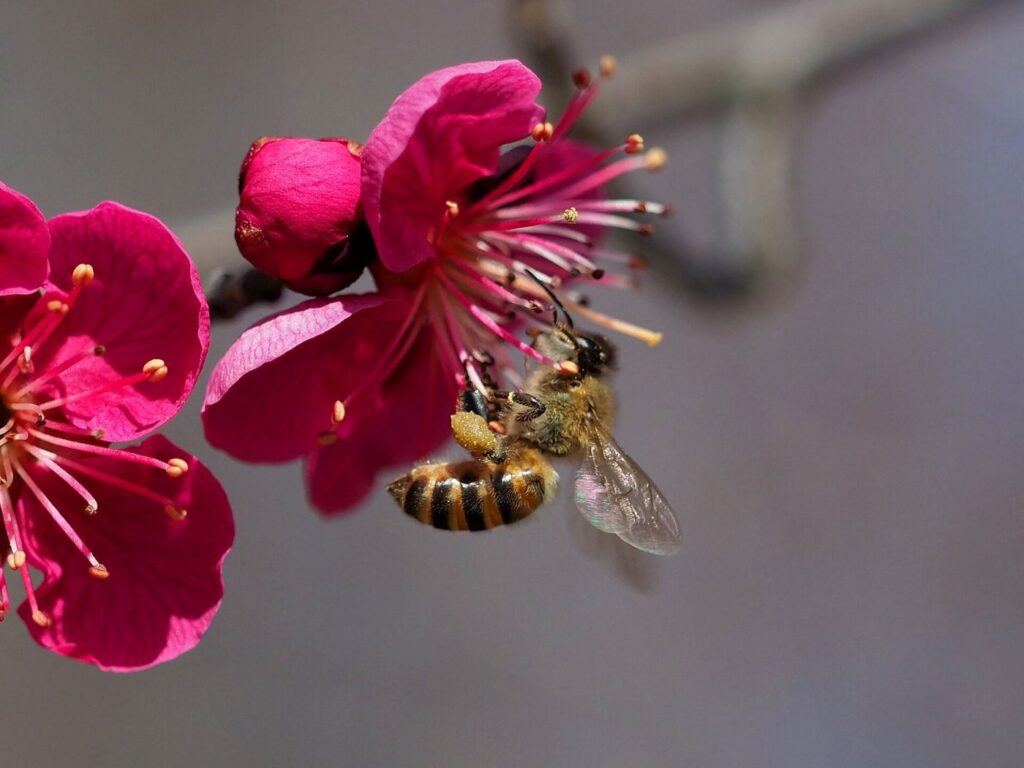
A bee visiting many kinds of flowers is not just collecting a varied diet for itself; it may be dosing itself with natural defences. Ecologists studying wild and managed bees have found that individuals foraging across a diverse range of wildflowers carry lower loads of several common parasites than bees restricted to a single crop or flower type. Different pollens contain different compounds, and some appear to interfere directly with parasite growth in the bee’s gut, while a more balanced diet also supports a stronger immune system overall. The findings help explain a pattern farmers and conservationists have noticed for years: bees working landscapes rich in hedgerows, meadows and flowering field margins often appear healthier than those in vast single-crop fields, even when the total amount of flower is similar. Diversity, it seems, matters as much as abundance, turning the structure of the whole landscape into a factor in pollinator health that can be managed deliberately rather than left to chance or good fortune alone.
What the Evidence Shows
Researchers are careful to separate the effects of diet from other differences between landscapes, using controlled feeding experiments in which bees receive identical parasite exposure but different pollen mixtures. Those trials confirm a genuine protective effect from several pollen types, and scientists are now identifying which plant families contribute most, so that seed mixes for field margins and urban plantings can be designed with bee health explicitly in mind. The work has practical implications beyond conservation areas. Growers who depend on pollination for fruit, vegetables and seed crops benefit directly from healthier bees, and planting diverse margins can complement reduced pesticide use as part of an integrated approach. There are limits to what flowers can do: parasites spread readily in crowded colonies, and habitat measures cannot substitute for good beekeeping and disease monitoring. Even so, the picture emerging is encouragingly actionable. Restoring flower diversity is something landowners, councils and gardeners can all contribute to, and the bees repay that effort measurably. Reporting and analysis from sources such as Nature track the same developments, and specialists following the wildflower diversity effect on bees say the direction is now consistent across independent lines of evidence.
The Wider Context
The wider context is a research landscape in which replication and open data now decide reputations. Findings connected to the wildflower diversity effect on bees are being checked by independent groups with shared datasets, and the teams involved publish their methods in full so rivals can test every step. That discipline is slower than a headline cycle, but it is why results in this area increasingly survive first contact with scrutiny.
What Happens Next
What happens next in the story of the wildflower diversity effect on bees will be decided by follow-up work already under way: larger samples, longer observation and instruments that have not yet come online. The researchers involved are unusually united on one point, that the current results justify the next investment of time and money. Readers will not have to wait long for the first tests of that claim. You can follow related developments in our coverage of science.
None of this will be settled by a single announcement, study or product launch. The pattern to watch is accumulation: independent confirmations, honest reporting of failures and steady improvement in the underlying numbers. Readers who follow those signals, rather than the loudest claim of the week, will understand this subject better than most of the commentary surrounding it suggests is possible.
