
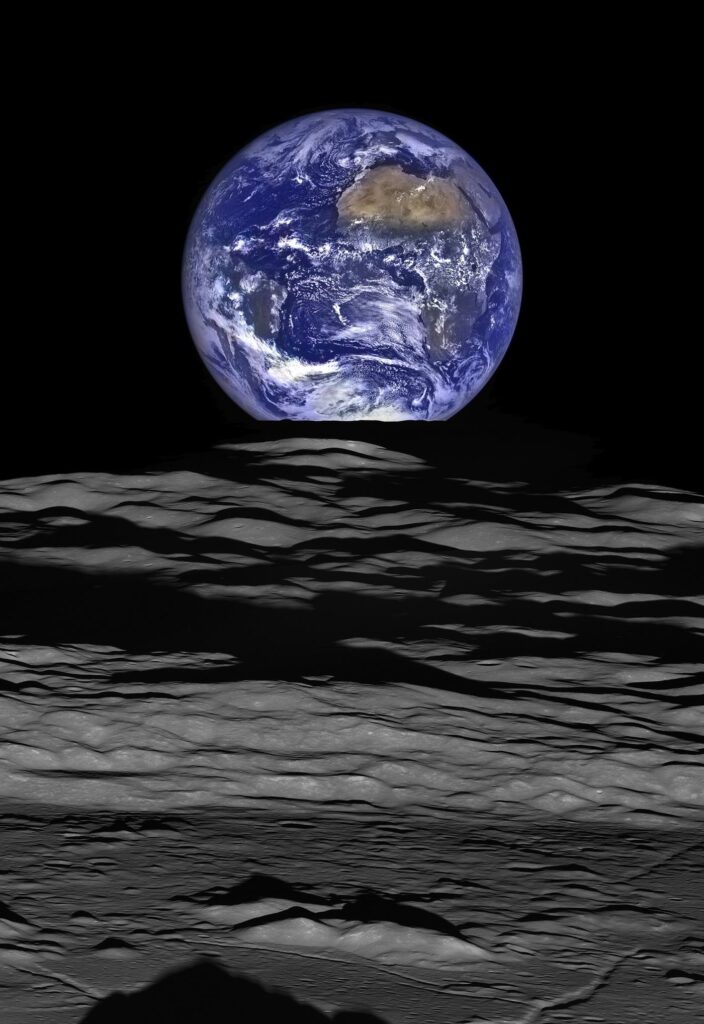
Lunar craters could act as free radiation shields for the nuclear reactors that will power future moon bases, according to a study reported on 25 November 2026. Researchers from Los Alamos, NASA Glenn, Oak Ridge, Idaho National Laboratory and Lockheed Martin presented the idea at the American Nuclear Society’s Nuclear and Emerging Technologies for Space conference, and the paper is available through NASA’s technical reports server. Their solution is simple: place the reactor behind a natural crater wall or dirt hill so the terrain blocks the direct line of sight to the habitat. Computer simulations showed the barrier cut reactor radiation reaching the crew to about one-tenth of a rem per year, roughly 50 times below the five-rem annual limit.
What the Evidence Shows
The team, led by Los Alamos researcher Alex Levinsky, used Monte Carlo N-Particle software to simulate millions of subatomic particles streaming from the reactor core. They tested the idea at Connecting Ridge, a mountain ridge near Shackleton Crater at the lunar south pole, where a 120-metre-high crater wall separated a simulated base camp from the reactor. With that barrier in place, radiation hitting the habitat dropped to near zero, about four-hundredths of a rem per year, letting the reactor’s onboard shadow shield focus only on nearby electronics. The catch is that the area inside the crater becomes a death zone, so crews would need to keep their distance from the reactor itself. Reporting and analysis from sources such as Nature track the same developments, and specialists following the lunar crater radiation shield idea say the direction is now consistent across independent lines of evidence.
The Wider Context
The wider context is a research landscape in which replication and open data now decide reputations. Findings connected to the lunar crater radiation shield idea are being checked by independent groups with shared datasets, and the teams involved publish their methods in full so rivals can test every step. That discipline is slower than a headline cycle, but it is why results in this area increasingly survive first contact with scrutiny.
What Happens Next
What happens next in the story of the lunar crater radiation shield idea will be decided by follow-up work already under way: larger samples, longer observation and instruments that have not yet come online. The researchers involved are unusually united on one point, that the current results justify the next investment of time and money. Readers will not have to wait long for the first tests of that claim. You can follow related developments in our coverage of science.
None of this will be settled by a single announcement, study or product launch. The pattern to watch is accumulation: independent confirmations, honest reporting of failures and steady improvement in the underlying numbers. Readers who follow those signals, rather than the loudest claim of the week, will understand this subject better than most of the commentary surrounding it suggests is possible.
